Splitgate 2’s ambition to “make FPS great again”—as emblazoned on the eye-catching hat of 1047 Games co-founder Ian Proulx—is undercut by gunplay that bears an uncanny resemblance to Halo 5: Guardians (hardly a standout entry in the genre) and movement that superficially copies Apex Legends, without the kind of environments that would make its aerial combat feel impactful.
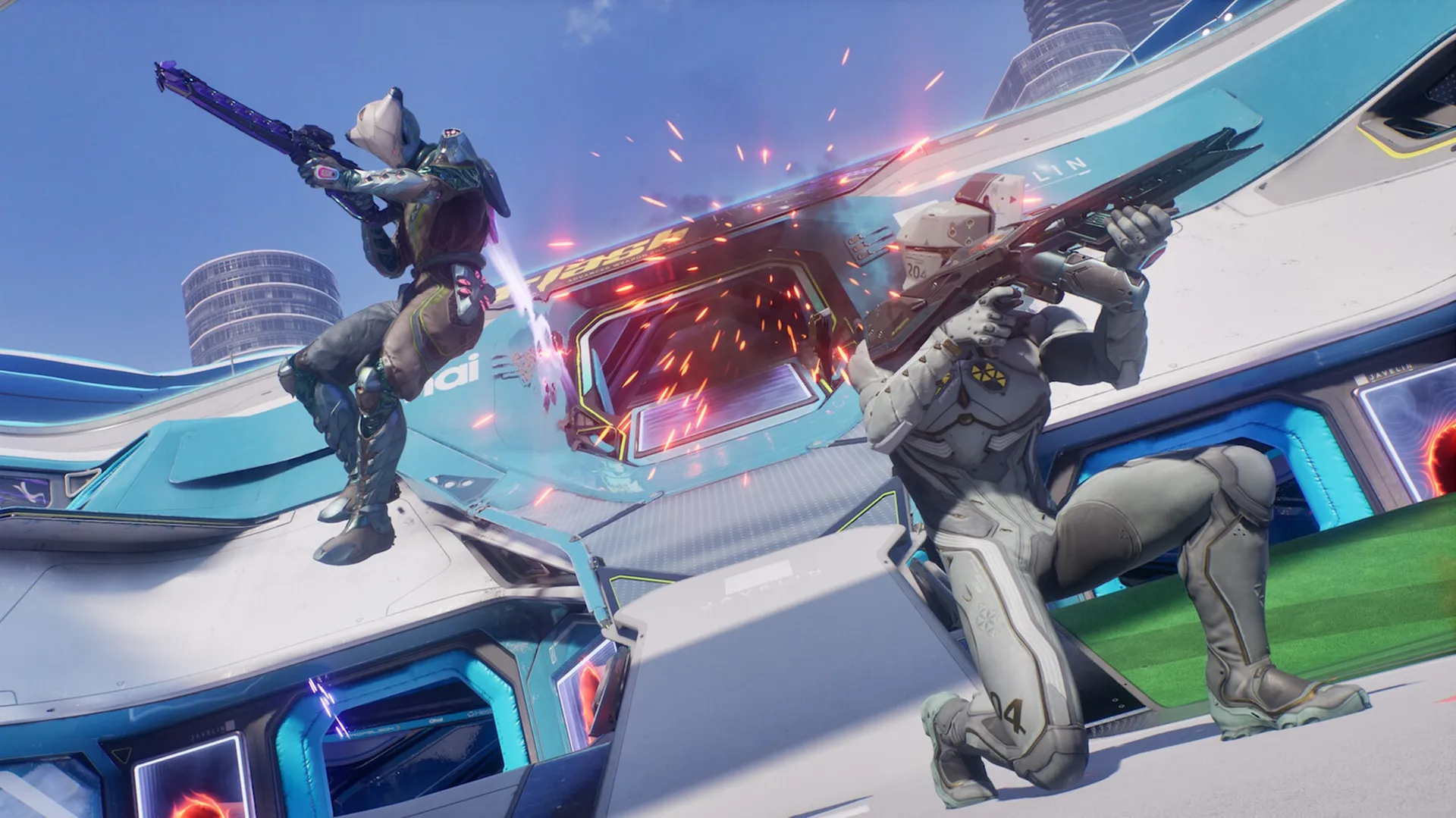
There’s a certain comfort in Splitgate 2’s familiarity, and I was caught off guard by how easily I slipped back into the habits of a seasoned player—seamlessly combining my Splitgater’s modest selection of grenades, abilities, and melee strikes to rack up multi-kills. Yet its signature feature fails to impress, and both the maps and weapons lack distinct personality, leaving Splitgate 2 feeling like a passable free-to-play time-killer, but nothing more.
What’s supposed to set Splitgate 2 apart is its portal mechanic, which functions similarly to those in Valve’s iconic puzzle games. However, in its 4v4 deathmatches, there’s little incentive to “think with portals” thanks to laser-precise gunplay and a fast time-to-kill (TTK).
Even in the surprise battle royale mode—announced just days before launch—I haven’t found portals to be of any real use. When I did utilize them, it was always to jump through an opponent’s portal and take them out in close combat.
Across all its modes, Splitgate 2’s portals come off as a major strategic and tactical drawback. More often than not, it’s better to focus solely on shooting your enemy than to distract yourself with on-the-spot spatial puzzle-solving. With a quick TTK and barely noticeable recoil, sharp aim is usually the key to securing a kill—not setting up portals for maneuvers that might prove tactically useless amid the ever-shifting chaos of combat.
The trickshots showcased in the game’s trailer are technically possible, but in my experience, they can and often will be foiled mid-execution by an opponent who understands that once you engage an enemy, your priority should be eliminating them rather than showing off.
Portals occasionally have their uses: peeking around corners, for example, or regaining position after falling from a map’s highest points. But with so few surfaces that can support portals, it’s a feature I rarely felt compelled to use. All of my best performances—including a 15-kill streak—happened when I completely ignored placing portals and focused entirely on the gunplay.
I don’t doubt that portals have significant tactical potential at Splitgate’s highest competitive levels, but I can count on one hand the number of times I was able to use them to my advantage. Over a dozen hours of play, I never encountered anyone who could outsmart my gunfire with portal tricks.
One area where Splitgate 2 breaks from its arena FPS roots is its class system: three distinct classes, each equipped with unique abilities like wallhacks, shield barriers, and speed boosts.
Each class also has its own weapon set, with guns falling into archetypes like assault rifles, submachine guns, carbines, and shotguns. The differences between these weapons are minimal, resulting in a weapon selection that feels unnecessarily cluttered. When you factor in power weapon spawns, an average Splitgate 2 match can have four types of shotguns in play—three of which are unpleasant to use.
The maps are equally uninspiring. I often struggled to find any surfaces to place my portals on, as most portal-compatible areas blend into the blob-like, Wipeout-inspired architecture.
Design-wise, Splitgate 2’s maps are most comparable to Halo’s: narrow basement corridors layered beneath wide-open plazas, with jump pads providing access to skyways. Everything has a clean, symmetrical layout, making each map feel balanced and well-suited for competitive play.
Unlike Halo, however, Splitgate 2’s maps lack any real character. They often feel like a clumsy reimagining of the old Designers Republic aesthetic for a modern FPS—neo-Y2K pink and blue color palettes slapped onto generic brutalist structures. Many of the larger maps feel eerily soulless, mixing disjointed elements like futuristic sports arenas with gravel quarries.
Halo’s timeless map design, by contrast, felt intentional and inspired: from Halo 3’s war-ravaged African brutalism to Reach’s drab Eastern European farming colonies—even the long-abandoned Forerunner battlefields had an eerie sense of history. Splitgate 2’s maps, on the other hand, all feel like your city’s mega-arena was haphazardly built on the remains of a strip mine.
I wouldn’t be so critical of the aesthetic if Splitgate 2’s monetization wasn’t so obtrusive. Upon launching the free-to-play title, I was greeted with two tiers of season passes, three separate currencies, and a cosmetic store filled with bundles that cost as much as a copy of Helldivers 2. I’ve purchased my fair share of cosmetic items over the years (mostly in War Thunder), and while beauty is subjective, $40 for what’s on offer here is absurd. There’s also a standard Battle Pass, but rewards are doled out slowly, tied to completing daily and weekly challenges.
If you thought the battle royale genre was already stale, Splitgate 2’s take on the format will make you long for something fresh—it’s a perfect example of “We have Apex Legends at home” (there’s even an unapologetic 1:1 copy of Titanfall/Apex’s Kraeber anti-material rifle). Its map is a lackluster patchwork of the game’s already bland arena maps, lacking the character, purpose, and visual appeal of other battle royales.
Dropping into this futuristic hodgepodge is clunky and unintuitive, with few clear visual cues to indicate high-risk, high-reward areas. Every match I played started with an awkward back-and-forth to decide who would be the jumpmaster, before someone inevitably landed us in another indistinguishable neon quarry filled with the same mediocre loot.
Gunfights are slightly more enjoyable in battle royale, thanks to the increased TTK provided by disposable shields. With more health to deplete, you’re forced to approach fights more strategically—using your abilities more often and focusing fire with your team. Looting, however, completely kills the momentum of a great firefight. During lulls between skirmishes, I found myself craving the next fight so badly that I didn’t care whether my team won or lost the match.
Beyond being generally tedious, Splitgate 2’s bland arsenal lacks any real differentiation. It’s not like PUBG, where choosing between a heavily modded AK-47 and a scoped rifle has real meaning—it dictates how you navigate the map and engage with the environment. Splitgate 2’s weapons flood you with nearly identical carbines and scoped assault rifles, only occasionally offering a power weapon worth fighting over.
In the end, my biggest takeaway from Splitgate 2’s battle royale mode was a wish that its higher TTK would carry over to the arena mode.
Despite a bold marketing push to position Splitgate 2 as a return to FPS greatness, there’s very little here that hasn’t been done better before. The game plays like Halo 5 (and sometimes Apex Legends) with portals—a mechanic that should be transformative but is rarely relevant.
Ultimately, I share the sentiment of 1047 co-founder Ian Proulx’s hat: if you’re craving a return to what Proulx calls the golden age of FPS, you’re better off playing Titanfall 2’s community-run Northstar client, your favorite Battlefield 24/7 Conquest server, or any other last-gen shooter that actually respects your time and money.


